
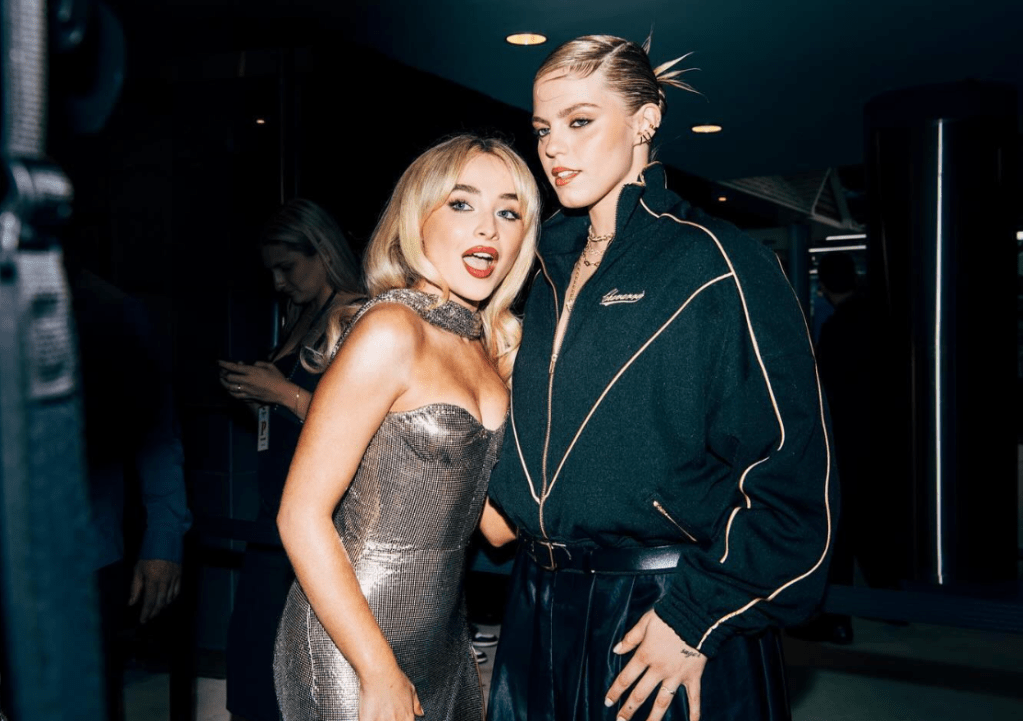
Picture this: you’re scrolling through your social media feed, catching up on the latest from your favorite artists. First, you see Renee Rapp’s Instagram “spam” account, @goodtitsbigheart, where she’s posted a new, half-blurry mirror selfie, captioned, “so many cities for such a little girl like me.” Her burner’s bio now reads, “touching road.” Even in its casual intention, the account showcases authenticity, giving fans a sense of connection to Rapp’s everyday life while hinting at her current mood. A few scrolls down, Sabrina Carpenter has shared a photo dump. Followers see a mirror selfie highlighting her bouncy blonde hair, a posed photo with Paul McCartney, a sign from Crypto.com Arena celebrating her six Grammy nominations, a Stevie Nicks Barbie doll, and behind-the-scenes shots from her Short ‘n’ Sweet tour. Her photo dump blends achievement and personality, reminding fans of her professional milestones, like meeting Paul McCartney and earning Grammy nominations, while also showcasing interests and personal quirks.
Renee Rapp and Sabrina Carpenter demonstrate two distinct approaches to connecting with fans on social media. Rapp embraces spontaneity and candidness, using her “spam” account to share moments that feel authentic, chaotic, and intimate. Carpenter maintains posts, both personal and professional, that align with her established aesthetic. While both engage overlapping fanbases, Rapp emphasizes relatability, whereas Carpenter balances personality with polish. So, why are both tactics successful in selling a pop star’s distinct brand?
Both approaches work because social media functions more as a tool for shaping public image than for deliberate marketing. “Back in the late 2000s, social media was really building up momentum, and there was a big discussion within the industry as to whether social media falls under PR or falls under marketing,” said Kevin Mercuri, Executive in Residence at Emerson College and CEO of Propheta Communications. “And I think for the most part, within the industry, social media aligns better with public relations, and we can work in tandem with the social media team to mirror positioning and messaging.” In this sense, their different strategies work because each singer uses their social media to clearly communicate what fans should expect from them.
“It’s a very diverse audience in the United States, and you could follow somebody who is an open book, whereas you could also follow somebody who’s more mysterious. And it still works,” said Mercuri. “I think it’s more than just that person’s content on social media. I also think it’s a larger CV of what their body of work is.”
When a big name like Taylor Swift drops a post on social media, fans bring a new set of expectations. Her authenticity is measured differently than that of most other celebrities. Someone who has reached the success and popularity of Swift isn’t afforded the same protection when baring all online. “I grew up watching her be ‘herself,’ open, honest, and, frankly, overexposed […],” said Capri DeBiccari, Director of Social and Influencer at GREY New York. “Those of us who remember her earlier days in the public eye, maybe 2007–2013, can recognize that it’s not a personality disappearing; it’s self-preservation and protection.”
Her persona online is shaped by her decorated career and loyal fanbase. Swift doesn’t need to be hyperactive online in order to reach her fans. She’s built up a reputation for leaving her fans “Easter eggs,” and has been known to drop clues for them to decode. “They’re effective because they’re intentional and rewarding. Taylor’s eras and Easter eggs turn fandom into participation. Sabrina’s character work gives people something to latch onto that’s bigger than any one post,” said DeBiccari. “These personas aren’t about spontaneity; they’re about storytelling. And I think more importantly, they’re consistent. Fans know what world they’re stepping into, and that predictability builds trust.”
Taylor Swift isn’t the only celebrity who intentionally curates a brand, or weaves through different aesthetics that represent an album or stage in their life, and it’s not just reserved for those in pop music. Country artist, Megan Moroney, does this too. Moroney’s Instagram bio reads, “professional emo cowgirl.” She’s embraced this title on every platform by blending country music with emotional lyrics, pop sensibility, and sparkly, vibrant imagery. Beyond this, she color-codes her albums, coordinating her performance outfits and social media posts with her chosen color scheme. Fans know exactly which era Moroney is currently living in just by viewing her social media profiles, and the same goes for Swift.
A cohesive display online is critical when trying to curate a specific aesthetic. Liam Alexe, Marketing Communications ‘27, has managed marketing and social media for Emerson Independent Video, including their production, The Nobodies. “I’m on set when they’re filming, but I also work with them during pre-production and post-production, to put out content and figure out what the branding looks like,” Alexe said. “The Nobodies is a ‘70s detective show, so it’s very curated with colors and fonts— we have it all put to a specific look and feel. So part of my job is not only just to get content, but to keep it in check with what the vision is.”
Sometimes cohesion comes through consistency in personality and tone. Similar to artists like Renee Rapp, some performers choose not to rely on aesthetics or distinct eras. Instead, they use their consistent, authentic personalities to keep fans engaged. “I think it just comes naturally to them, because they have told their social media team, ‘I want to be myself if I’m goofy,’” said Mercuri. “‘I want that to come through on my social media if I suffer from anything from a common cold to anxiety or depression. I want that to be part of it. I want to be open and honest , and transparent with the public. And I think that yields far better results, business-wise, than trying to create this persona.’”
Role Model, singer-songwriter, best known for his hit song, “Sally, When The Wine Runs Out,” has been successful at this. He’s another celebrity with multiple social media handles. Aside from his already candid @rolemodel account, he also runs the TikTok account, @saintlaurentcowboy. Saint Laurent Cowboy is Role Model’s alter ego, who the singer eventually claimed was impersonating him, when fans caught on to their very similar faces. Between the two accounts, Role Model, whose real name is Tucker Pillsbury, gives fans a very chaotic and comical glimpse into his life and sense of humor. In September 2024, Pillsbury began a campaign to win People magazine’s ‘Sexiest Musician Alive.’ He was nominated against Harry Styles, who ultimately won the award. Leading up to the race, he campaigned on TikTok, saying he was the underdog. At night, he would occasionally rock a T-shirt on stage, saying, “Nominated Sexiest Man Alive.”
When he lost, Pillsbury accepted his defeat in a video for fans, saying, “I want to speak to those who voted for Harry Styles. I hope you’re happy. I hope your day is made from this, because guess what? His publicist isn’t even going to mention this to him.”
DeBiccari explained, “that level of perceived chaos is rarely accidental. The safeguard is a very clear internal understanding of what’s off-limits. Even if the delivery feels impulsive, the boundaries aren’t.”
That’s how Role Model’s blunt humor is able to land. His tone is recognized as a joke among fans, but even if it weren’t, it wouldn’t matter. “You want to get people to feel like they’re in on something,” Alexe said. Role Model has built a fandom by letting his audience in on the joke. While inclusive enough for anyone to join the fanbase, it still feels exclusive, because fans aren’t just watching the bit unfold; they’re participating in it. By blurring the line between performance and personality, Pillsbury turns his content into a shared inside joke, strengthening the parasocial bond that keeps fans laughing with him.
A fan, @glindasuee, shared to X: “this role model guy is so unserious, i might have to stan,” while an official member of “Tucker’s community,” an X subculture dedicated to Role Model supporters, @ysllcowgirl shared: “when i’m mad i chew on this poster of role model.”
Together, these artists show that there isn’t a singular successful tactic in building a persona online. Whether effortless and silly, or curated and polished, audiences tend to respond to anything they’re invited into, while also being offered a sense of continuity. “Authenticity, to me, is alignment. The brand behaves the way you’d expect it to behave given its values, history, and tone,” said DeBiccari. “When people say something feels inauthentic, it’s usually because it’s inconsistent or opportunistic, not because it’s polished.”
So, picture it again: you’re scrolling and come across Role Model’s new Instagram post. The thumbnail image is a mid-motion, unposed selfie, captioned, “tour is over, my 15 minutes are almost up, i’ve been working hard on little miss RM3, birkin has yet to show face.” Right beneath, Taylor Swift is announcing her docuseries, The End of an Era, and like almost everything she posts, it’s technically precise and polished. In the end, these examples show that there isn’t a correct way to connect with fans online. Renee Rapp’s candid posts, Sabrina Carpenter’s curated photo carousels, Role Model’s chaotic humor, and Taylor Swift’s “master-minded” announcements all succeed because they are consistent with each artist’s persona and invite fans into their world.


 Popline News