

Kristi Noem’s fully bronzed and sparkly face with bouncy waves to watch ICE operations. Erica Kirk’s white suit, unrelenting smoky eye, and perfectly applied mascara to eulogize her assassinated husband. A look deemed the ‘Mar-a-Lago’ makeover has swept through high-ranking DC officials during Trump’s second term. Many have dismissed the overly-done look as a simple makeover, but what does the embrace of the Mar-a-Lago’ tell us about the values of the Trump administration and American society at large?

These high-visibility, republican women are embracing this aesthetic in their makeup, fashion, and faces, as many undergo drastic cosmetic alterations. Despite the high-profile makeovers, DC-area makeup artist Kayla Balkin explained that the DC area has relatively conservative makeup trends in comparison to places like Arizona or San Diego, where makeup tends to be more bold.
“It looks like a newscaster to me. It’s full glam, bolder lashes, voluminous hair, and a blowout with curls,” Balkin said. It’s also associated with spray tans, in addition to cosmetic alterations including botox, jaw contouring, and extreme facial plastic surgery.
For Balkin, the trend hasn’t swept her client base. She noticed this trend in 2016 (Trump’s first term) when full glam, full lips, and intense eye looks were everywhere. Interestingly, she does expect the full-glam look to come back in full swing in the next few years.
Plastic Surgery is also a unique way that the right has fulfilled the ideal of femininity. Plastic surgeon Matthew J. Nykiel told HuffPost that the Mar-A-Lago face is the combination of distinct features that mirror Ivanka Trump’s facial look (The Week). These surgeries are not cheap. Nykiel said that surgeries can go for around $90,000, and keeping the face looking fresh is an additional chunk of money.
In an interview with Dr. Alannah Phelan, a Boston-area plastic surgeon, she explained that her patients rarely come in with requests for a bold, overfilled, Mar-A-Lago look. In New England, patients more often opt for a conservative and natural look, a trend that reflects the region’s trendsetters and public figures.
“I would attribute it to regional cultural differences,” Phelan said. “I think it also pairs with the figures identified in this area as trendsetters. There’s certainly regional variation in celebrity culture too.”
In addition to plastic surgery and beauty trends, we also see the intersection of politics and fashion as 2025 has been the year of muted colors, blazers, and more subdued office-wear. Trends in fashion can also be linked to Trump’s tariffs, as pieces that may be “basics” or timeless are smarter purchases in an extremely insatiable global economy (Stiegman).
Longtime stylist Eloiza Ramos noticed trends, specifically in relation to politics and the economy.
“The economic climate has added some stress to the panic of shopping, less and less people are consuming than before,” Ramos said. “Especially as the years go on, I think people want to buy something that they know will last them past the years of trends. Even if it’s considered more simplistic.”
She explained that customers now are looking for more coverage in their outfits, as opposed to a few years ago. Less statement pieces, and more staples.
“I feel like conservatism kind of pushes forward this “modest” fashion agenda,” Ramos said. “Not to say that modesty equals conservatism but it is definitely something that conservatives emphasize. It’s a judgment that’s specifically placed upon women.”
Makeup, plastic surgery, and fashion trends among MAGA have not swept the general
population, but are still frequent among high ranking officials in Trump’s administration. This may reflect more of the alignment with Trumpism than adherence to a trend in beauty overall.
But first, to understand the intersection between politics, beauty, and fashion, we must look back to England in the 16th century. Inae Oh wrote in Mother Jones, “During Queen Elizabeth I’s reign, artificially blackened teeth were considered fashionable among those who wanted to mimic the genuinely decaying teeth of a monarch who consumed too much sugar.” Mimicking those in power to get power is nothing new, yet continues to reinvent itself through the years.
Beauty is extremely reactive to politics of the time. The Biden administration (and Harris campaign) embraced colorful, eccentric aesthetics, and the scope of fashion and beauty were much larger (think of the BRAT branding). The Biden administration’s end in 2024 signaled a shift to a different era, one of a radically different aesthetic.
Kelsey Stiegman of Teen Vogue explains, “Today, as masked ICE agents kidnap immigrants in broad daylight, cops shoot rubber bullets at peaceful protesters, and tanks crawl through D.C. — the whimsical -cores and aesthetics that flourished in past eras are at odds with our current ecosystem,” which is reflected in the fashion of high-ranking right-wingers in DC.
This new MAGA aesthetic, as many journalists and sociologists have suggested, is more than just a trend but a declaration of values and perhaps a signal of submission to the right’s fixation with tradition and family values. There is also an extreme regression in terms of rights for marginalized individuals in recent years, including the overturning of Roe V. Wade and continuous attacks on the transgender community, in addition to wide reversals of DEI initiatives nationwide.
Stiegman writers, “Fashion is no longer just about personal taste — it’s about survival, self-preservation, and signaling. What we wear has become armor against a culture of instability.” This idea can absolutely be translated to the world of makeup and beauty, which is perhaps even more linked with survival and signaling, as it is impossible to take off a facelift or botox.
Femininity is quite a loaded term, but today it has been used often by the alt-right to signal a return to traditional values. Megan L. Zahay wrote an academic article about the rise of anti-feminist vlogs and trad wives, and said, “At the same time, the term “femininity” functions as a shorthand for a host of political and extremist ideologies that can be accessed through gender traditionalism,” which can explain much of the right’s obsession with women doing gender in a very specific way.
To underscore this messaging, Marie Claire’s Nessa Humayun interviewed Melissa Rein Lively, who is the founder of America First PR, which brands itself as an “anti-woke” PR firm. Lively said, “The Trump woman is elegant, powerful, hyper-feminine and always looks impeccable. Femininity is our weapon, and by being beautiful and elegant, you can get a lot more out of life than you can by looking like crap,” which can begin to tell the story of what Mar-A-Lago face is all about.
The same article went on to explain that adhering to MAGA aesthetics allows women a very narrow path to power, one that hinges upon an embrace of conservative male-dominated spaces (Marie Claire).
In an article for The Guardian , Einav Rabinovitch Fox explains how fashion and beauty aim to appeal to a sense of identity, and the meaning of certain aesthetics can change depending on political situation. Fox reported, “Sociologist and American University professor Cynthia Miller-Idriss, who studies extremism and polarization, wrote“it is simply much harder to recognize ideas as hateful when they come in an aesthetic package that doesn’t fit the image people hold in their heads about what white supremacists look like” When the radical right looks like the mythical boy and girl next door, it’s hard to know who can be a threat,” which emphasizes the confusing contradiction we see when Noem enforces Trump’s cruel immigration policy with perfect, bouncy curls and a full face of makeup.
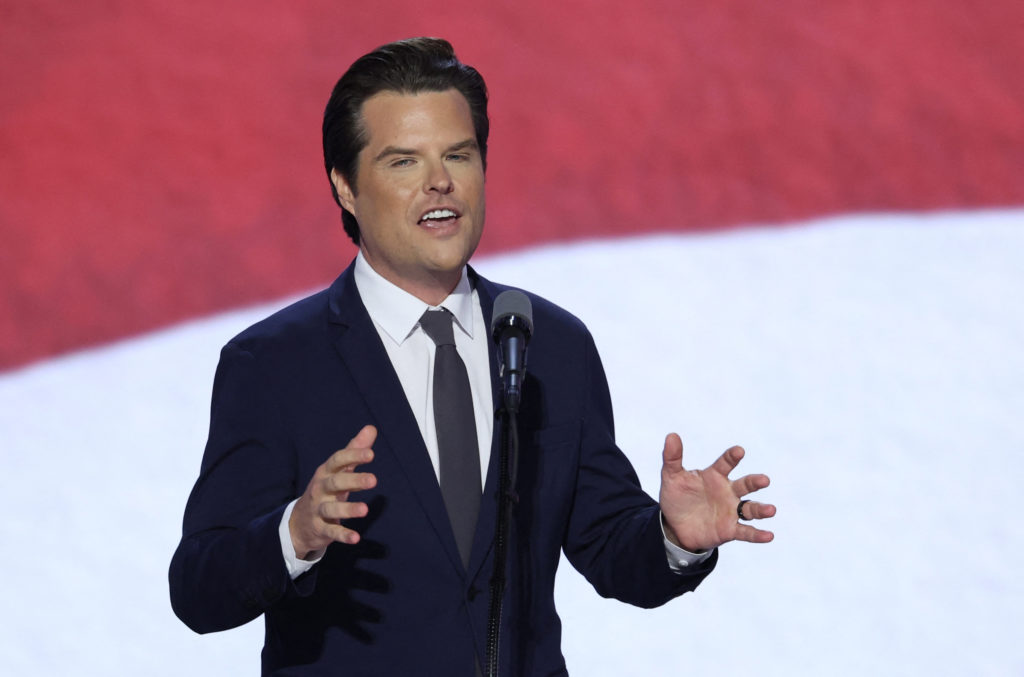
It often seems that the higher up an individual is in Trump’s cabinet, the more plastic surgery or the more extreme their faces get. Inae Oh for Mother Jones explains that plastic surgery is somewhat of a certification to work under the Trump administration: “It isn’t far-fetched to imagine these women and men—former Rep. Matt Gaetz (R-Fla.), to start—believing that going under the knife could be a form of legitimate labor, getting the literal work done to maximize one’s economic and political standing.”
In her article, Humayun posits that “The “MAGA face” promises strength but delivers obedience and dresses up control as confidence. Beauty, here, isn’t liberation. It’s the leash,” which is clear when republican women are dressed impeccably, arguing for the destruction of decades long protections that support women.
A more careful examination of the elite republicans in DC shows a clear pattern, which is high-glam, high-surgery, and high-adherence to a strict model of femininity. The right’s political project in the US hinges upon the idea of a traditional family, so the embrace of femininity as a means to enact wide-sweeping change is key to their project. Amanda Marcotte from Saloncalls the Mar-A-Lago face a “physical submission to Trump,” which seems appropriate given the extreme procedures and looks across the right aimed to appeal to a certain brand of conservatism.
Criticisms of the MAGA look are frequent on social media, but the right is still embracing this look, and they praise women who adhere to this strict version of femininity. President Trump talked about Karoline Leavitt saying, “She’s become a star. It’s that face. It’s that brain. It’s those lips, the way they move. They move like she’s a machine gun.” The Mar-A-Lago face is much more than a makeover, but it reflects an alliance to an ideology hinged on formulaic femininity, which serves the traditional family model. So when the filler dissolves, what will be left behind?

 Popline News