
“How dare you, Mr. Spears? You had me fooled. And you too, Mrs. Spears–death, to all of them!”
These words, said by former talk show host Wendy Williams back in 2021, shocked viewers nationwide. Her outrage spawned from the most recent testimony given in Britney Spears’ conservatorship trial, delivered by the pop star herself. The then-39-year-old singer spoke for 24 minutes about the alleged horrors she faced under her court-appointed conservatorship that began in 2008. Spears visited rehab several times that year and was committed to a psychiatric hospital. In response, the Los Angeles Superior Court granted her father, Jamie Spears, control of her finances, health, estate and business ventures for the duration of the guardianship. It was only after fans began to notice some strange online behavior in 2020 that the #freebritney movement began. And on June 24, 2021, it appears Wendy Williams had heard enough.
The clip of Williams went viral online for its shock value and violent call to action. But it also sparked a wider conversation about the treatment of child stars in Hollywood. Spears entered the spotlight at age 10, performing Off-Broadway in “Ruthless” before joining the cast of “The All New Mickey Mouse Club” two years later in 1993. On this show, she acted alongside fellow stars Christina Aguilera and Justin Timberlake. But it wasn’t until she released her debut single “Baby One More Time” in 1998 that Spears fully entered the male gaze. The song’s music video features Spears dancing in a private school uniform with a cropped white collared shirt, showing some of her bra. The video plays into the “sexy school girl” trope popularized by adult films in the 80s. Spears was only 16 when the video dropped.
Her rise to stardom was rapid; just two years after her music debut, Spears broke the record for the fastest-selling album by a female artist in the U.S. for “Oops!…I Did It Again.” But just as quickly as she reached superstar status, the media frenzy around Spears’ personal life began to take full speed. Paparazzi cars followed her all over Los Angeles, documenting her widely publicized mental breakdown in 2007, where she shaved her head and hit a photographer’s car with an umbrella. Spears was sexualized by producers, harassed by the media and financially controlled by her parents all before she turned 18. But when outlets reported on her mental breakdown, they claimed no responsibility for her downfall.
In recent years, many former child stars have opened up about the trauma they faced behind the scenes of their most successful projects. It’s hard to forget “Sam & Cat” star Jennette McCurdy’s tell-all book “I’m Glad My Mom Died,” which she released in 2022. McCurdy writes about the eating disorders she battled on the set of iCarly, in addition to multiple terrifying encounters with a powerful male figure whom she refers to as “The Creator.” But above all else, McCurdy describes the abusive relationship she had with her mother. She claims her mother, Debra McCurdy, forced her into acting at the age of six, even though she had no interest in it. McCurdy says acting was Debra’s unrealized dream, and she forced it onto her.
Just like McCurdy, Spears grew up in a tumultuous environment. Her father, Jamie, was an alcoholic, and in her memoir, “The Woman in Me,” Spears writes, “my mother and father fought constantly. He was an alcoholic. I was usually scared in my home.” Spears’ family was lower-middle-class when they lived in Kentwood, Louisiana. But once they discovered Spears’ knack for performing, everything changed.
The phenomenon of parents forcing their children into the spotlight to feed their own ambitions is a common occurrence in Hollywood. Jane O’Connor, editor of the 2017 book Childhood and Celebrity, says parents often live vicariously through their children to fulfill their own dreams of stardom.
“It means that you’re still part of that world. Even though you’re not the star, yourself, you’re still in that world of movies and celebrities and all that exciting stuff through your children,” says O’Connor. “As soon as the money comes into the picture, it seems like this morality around children and childhood is vulnerable to being ignored.”
Since the beginning of mass cinema culture, Hollywood has been obsessed with child stars. One of the earliest examples of this is film legend Jackie Coogan. Charlie Chaplin discovered Coogan in 1919 and cast him in his film, “The Kid.” The 1920s were an excellent time for Coogan, as he became the poster boy for some of Hollywood’s biggest projects. But on his 21st birthday, Coogan discovered he had no money to his name. His father, who died prior to his birthday, had taken all of his earnings. At that time, the industry didn’t have any laws protecting the finances of children. As a result, the state of California passed the Coogan Law in 1939 to ensure that employers put at least 15% of the child’s earnings into a “coogan account,” which they can access when they’re older. Though this legislation represented a positive step towards accountability in Hollywood, the mass cultural obsession with child stars in the United States was only just beginning. To put it plainly, American media consumers love child stars.
“They’re just such a fascinating phenomenon. They just keep popping up in every period of time,” says O’Connor, who earned a PhD in childhood sociology and cultural studies. “They come back in a new form, but there’s always this desire for them. There’s always this cultural significance that they hold. We want to see a few children sparkle and take center stage.”
The cultural reverence for young children is well-documented outside Western cultures. In fact, O’Connor says it can be traced back to ancient mythology: “There’s always the child god, or the ‘wonder child’ who appears in stories. So it’s almost like there’s this need in our psyche to reify a few children.”
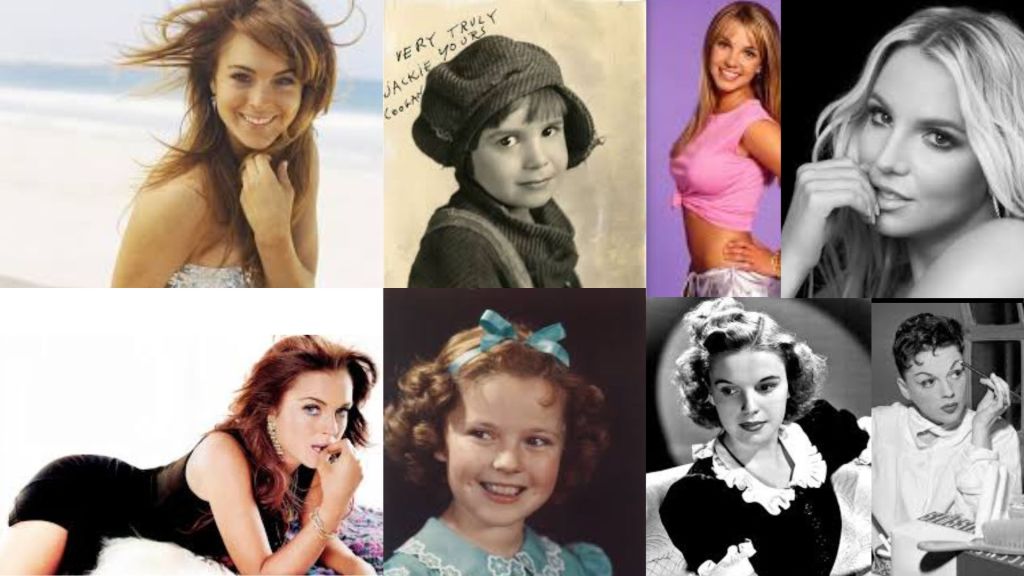
In terms of American media, child stars represent childhood innocence, vitality and wonderment. The most popular actors, such as Lindsay Lohan and Shirley Temple, radiated a sort of youthful ambition. They intrigued viewers with their larger-than-life personalities, and sometimes, behaved in ways far beyond their age. For young girls, they have an almost idealized femininity.
“There’s something about young girls that almost embodies the feminine ideal of beauty because they’re so young, they’ve got beautiful skin […] or if it’s boys, it’s that cheeky cuteness,” says O’Connor.
While child stars may be a hot commodity in Hollywood, some developmental psychologists say the pressures of stardom could affect their relationships as they grow up, due to the lack of stability in their youth. Boston College Professor Jacqueline Lerner says a reliable family dynamic is crucial for kids in the spotlight.
“I think some people can navigate it with the right support. I don’t think there’s a definite link to problems. When you think of the older child stars who have spoken out about it, like Jason Bateman, in his mid or late 50s, he talks about it as having paid the bills, and he seems quite well adjusted,” says Lerner.
The danger, however, comes when children are forced to work grueling hours without any time for social interaction with peers.
Lerner says, “it disrupts attachment with parents, it disrupts peer relationships, it disrupts identity formation. If you think about it, the young kids are not really giving consent. A three-year-old who can act is not really saying ‘I want to do this.’”
Consent is an important part of the narrative surrounding morality and child stars. At what age can a child really consent to being on camera? Lindsay Lohan starred in Disney’s remake of “The Parent Trap” when she was eleven years old. “The Wizard of Oz” star Judy Garland was just eight years old when she began acting in short films. Both Lohan and Garland went on to struggle with substance abuse and alcoholism in their adult lives. Lohan was arrested twice for DUI and charged with possession of cocaine. She faced jail time for theft of a necklace. In recent years, Lohan re-entered the public eye and has been celebrated for her clean “rebrand.” Unfortunately, Garland never got that chance. She died from an overdose in her London home when she was 47, leaving behind three kids. Growing up around self-serving adults, working a full-time job, and barely spending time off set can severely disrupt a child’s development. Both Lohan and Garland were introduced to the world of drugs and alcohol at a young age. That’s the unspoken caveat of being a child star: adults expect you to party the same way other actors party, regardless of your age. “ET” actress Drew Barrymore says she developed a drinking problem by age eleven. She says her mother took her out to party almost five days a week when she was just eight years old.
“Living vicariously through your kids is probably a very bad style of parenting,” says Lerner. “It takes a toll on youth.”
Lerner says there’s absolutely “nothing unstressful about being a child star,” especially when the family dynamic is already unstable. She says there are ways that parents can try to protect their kids from the dangers of early stardom, but it is not easy.
“It’s an unusual kind of pressure, it’s an unusual kind of childhood. It’s not what the developmental psychologists believe is healthy. That’s the bottom line. Can it be done in a healthy way? I’m sure there’s examples of it. But it’s complicated,” says Lerner.
With all the publicly documented downfalls of some of Hollywood’s most beloved child performers, industry insiders are finally speaking out about the rampant abuse that goes on behind closed doors.
In 2024, Discovery Plus released “Quiet on Set: The Dark Side of Kids TV,” a docuseries featuring interviews with actors from some of Nickelodeon’s most popular shows. It made headlines for its groundbreaking interview with former “Drake & Josh” star Drake Bell, who describes being sexually assaulted by a former dialogue coach. “Quiet on Set” added context to a conversation that’s been going on in Hollywood for a while now. If people finally understand how disruptive early fame is for kids who don’t have a solid support system, then why do they continue watching the movies and television shows that exploit them?
Lindsay Lohan just recently spoke to the Associated Press about her maternal feelings towards child stars who are entering the industry today. “I feel protective, for sure. I have something in me that’s always going to be that way, because it was so wild for me in my experience.”
As Hollywood’s focus on child stars begins to quell, a new medium is exploiting kids at a much faster rate, and in a much more personal way: social media. Family vloggers and “kid-fluencers” are some of the most popular creators online, with users like “The Ace Family” boasting millions of subscribers on YouTube. In 2023, former “mom-fluencer” Ruby Franke was charged with four counts of aggravated child abuse after one of her sons escaped and asked a neighbor for help. An investigation revealed Franke denied her children food, water and entertainment, and regularly forced them to do painful physical tasks to punish them. Franke and her accomplice were motivated by religious extremism. Despite the horrors that were going on in her home, Franke managed to present a wholesome family dynamic to her more than 2.5 million subscribers. Now her kids are not only plagued by the emotional and physical abuse they endured, but they also are known by millions of people for their viral online videos.
O’Connor believes greater society needs to take accountability for the unregulated exploitation of young children on the internet.
“We called for that, as a culture, and then this is the fallout of it,” says O’Connor. “I find it fascinating that culturally we still allow this. We just turn a blind eye to this.”
Social media takes the obsession with children to a whole new level because they are no longer portraying characters, but instead simply being themselves. Lerner says there’s a real danger of adults developing parasocial relationships with these kids.
“It’s a whole different way of wanting your kid to be famous. To me, that’s bizarre. There’s this kid that makes 8 million dollars a year testing out toys and stuff.”
With the growing popularity of kid-fluencers on social media, some lawmakers are taking a stand to protect the next generation of child stars. California Governor Gavin Newsom signed two bills last year to enhance protections for young influencers online. Now, children featured in monetized content online are entitled to a percentage of the videos’ earnings. Their parents must set aside their earnings in a trust account. Newsom also expanded the protections of Coogan’s Law. Former child star and activist Demi Lovato supports the legislation, saying in a statement: “In order to build a better future for the next generation of child stars, we need to put protections in place for minors working in the digital space.”
These bills are just one step towards making the industry safer for children. As new social media platforms continue to develop, parents can take active steps to ensure their kids are protected now and in the future. Lerner says it is important for parents to connect with their children emotionally in order to gauge how they’re feeling on set, on stage or behind the ring light.
“Watch your kid, make sure there’s no indicators of disruptions in emotion, in cognition, in biology that would lead you to think, ‘wow, this isn’t good,” says Lerner.
Whether or not this next generation of child stars will fall down the same paths as some of Hollywood’s former starlets has yet to be seen, but after studying the phenomenon at length back in the 2010s, O’Connor says she’s seeing a lot of cycles repeat themselves.
“With today’s kid-fluencers and social media personalities, I think it’s gonna happen all over again. And I think a lot of children are going to regret having grown up in public. You can’t take away a digital footprint, it’s there. […] I think that’s the danger.”



 Popline News