
“Honey, take it off.”
That was the call from the porch of Maine Street nightclub in Ogunquit, Maine, shouted by a group of crossdressers, as Arabella LaDessé, or Arabella “The Goddess,” was unveiled to the world of drag.
It was exactly what she needed to hear because thirty minutes earlier, Arabella was at a gas station on the New Hampshire border, feeling nervous about her first-ever drag gig that night.
“A truck, like right out of a movie, pulled up. A red truck with four redneck-looking men in it,” she recalls. “I was just like, ‘Oh yeah,’ and I got back in the car. I had no gas, running on E, and I was just so nervous. I was thinking, if that’s already how I feel, then maybe I shouldn’t do this.”
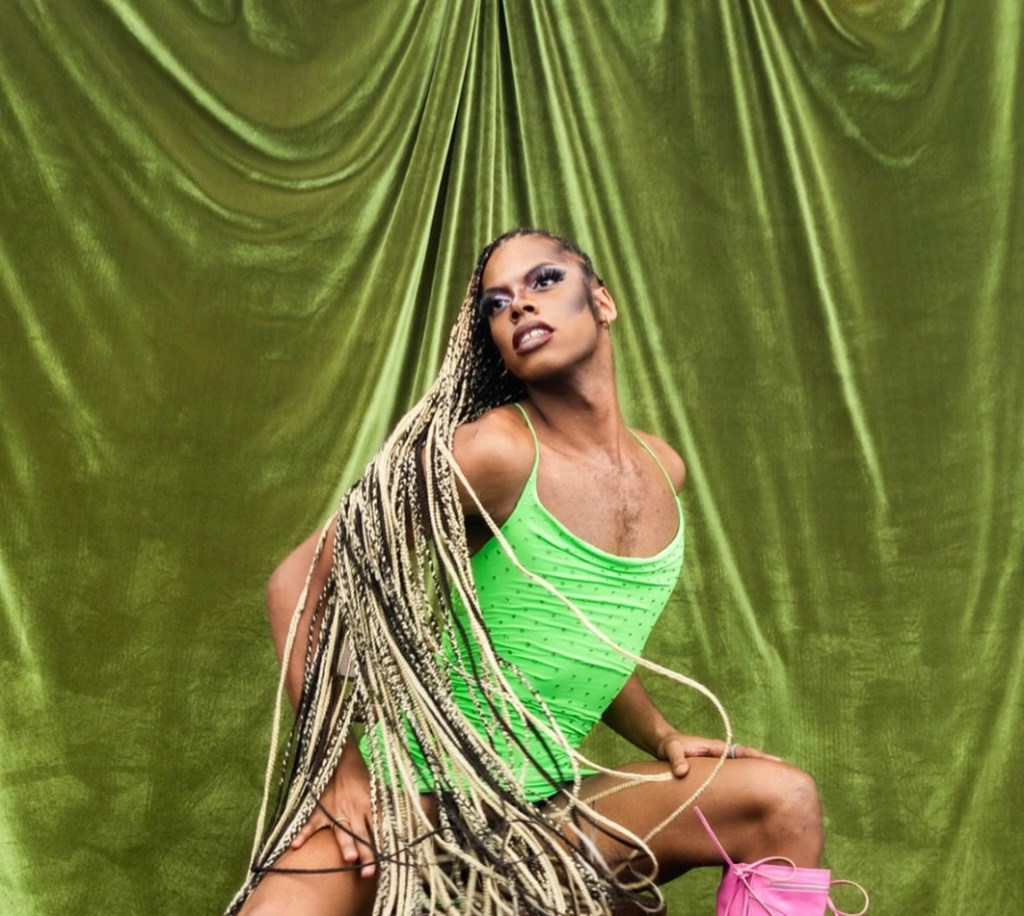
She made it to Maine Street, wearing a sequined green bathing suit and high heels under a large coat, adjusting her hair to frame her face. “So people can’t see the masculinity,” she said.
And that’s when she heard: Honey, take it off.
“I tore off the jacket and did a little spin,” Arabella said. “They clapped and cheered. I threw it over my shoulder and just kept walking in.”
That night, Cinco De Mayo 2018, Arabella “The Goddess” was born.
The Name Behind the Goddess
Her full name? Arabella RaLa Sekhmet Bastet Shiva Hathor Gabor Dior LaDessé. Each name of hers holds more significance for her drag persona than what meets the eye.
Arabella explained that outside of drag, her name is Rashawn, so she wanted her drag name to include “Ra” as well.
Originally, “Arabella” was a secret, “for when I wanted to be very pretty,” she said. So, she was going by Ra LaDessé, but it kept getting mispronounced, like RaLa Death or RaLa Deh. Ra, the Egyptian sun god, and LaDessé, French for “The Goddess.”
Eventually, her full name was curated by enlisting the help of gods and goddesses, honoring a deity or mentor that helped shape her identity, hence why fans know her by Arabella “The Goddess.” Arabella chose to represent herself with gods and goddesses that she resonated with.
Sekhmet represents the Egyptian goddess of war and healing. Bastet is the cat goddess and protector of the home. Shiva is the god of transformation. Known for transmuting energy, she can turn bad energy into good. In Arabella’s drag, Shiva also symbolizes crossing gender binaries and barriers. Hathor is a mother goddess of magic, beauty, and expression, and she is what Arabella channels in her performances.
Dior, named after Daniella Dior, a 65-year-old trans woman, is still performing in Portland, Maine.
“And Gabor, from Gigi Gabor, a non-binary goddess and queen who taught me about accepting my body in all of its forms in order to have the truest expression of my art.”
And of course, LaDessé, which translates to The Goddess.
A Drag Persona Rooted in Purpose
While Arabella’s costumes and makeup have grown more refined, her drag remains grounded in purpose, identity, and history— particularly as she navigates spaces where being Black, queer, and femme is often met with resistance.
“I had to really take back burner positions and really learn silence before I was able to speak,” she said, recalling early experiences in predominantly white environments. “In that silence, I learned to develop the voice that is able to make the change.”
Arabella sees drag as both personal expression and cultural commentary. To her, it’s an art form defined by individuality rather than conformity.
“Drag means something different to everyone,” she said. “What’s tricky about RuPaul’s Drag Race is that it’s really shaped how people think drag should look. But, there isn’t one way it’s supposed to be. Drag is so many different things; it’s a whole spectrum of art and experience.”
That sense of self and history extends beyond the stage. Arabella has spent more than a decade researching her family’s lineage, work she says has shaped her understanding of identity and legacy.
“I’m really big on genealogy,” she said. “I have 14 years of experience in genealogy, very specific to my family. And now I’m starting to branch out.”
Through that research, Arabella has confronted difficult truths about race and history that inform her art today. “As a mixed child, I’m able to read and see a lot of the details when it comes to slavery and how people were sold,” she said. “One of the biggest tactics was to not look the slave in the eye because they knew that if you looked someone in the eye, you’d see a person.”
Arabella ties this history to observations of our current society.
“This narrative on the news is that trans people are no longer people, that we’re terrorists, predators, child groomers,” she explained. “Black people are thugs, dangerous criminals. Drag queens, too. All these things are just objectifying. And we’re not objects.”
Arabella reflects on the culture of online discourse today, where political arguments and social media “unfollows” have made it easier than ever to disconnect from opposing viewpoints. She believes that this tendency to retreat into echo chambers can be harmful, especially when it silences opportunities for meaningful dialogue. When crises arise, she said, the very people who could have helped drive change may already have been shut out.
“So, don’t be so quick to remove people,” she continues. “Especially if you’re not from the marginalized community.”
Arabella’s Accessories
Her artistry combines her voice with her performance. “I think I’m a great performer,” she said with a smile. “So I mean, pat myself on the back with that one.”
Standing out in more ways than one, Arabella’s aesthetic is less about costumes and concepts and more about high fashion and Black femininity in its raw beauty. “I’ve never been super big on costume presentations,” she said. “I’m really more into fashion aesthetics like high-end fashion things. The costume-y kind of aesthetics feel harder for me because they fall apart when I dance. And I move a lot.”
In fact, Arabella’s most iconic accessory is her hair.
“When I started getting the braids, it was very quick to establish themselves as something that people really loved about Arabella,” she explained. “And in that, too, I found my own power outside of Arabella with them.”
Through performance, Arabella connects her soul and body.
“My braids, they dance with me. I’m conscious of them as any dance partner would be. And when I don’t have them, I get to truly, more or less, dance by myself.”
Arabella explained that if she ever cut her braids, she wouldn’t be quick to turn to a wig. Rather, she’d embrace the bigness of her natural afro.
That embodiment of Blackness and movement is what sets Arabella apart. Arabella brings her perspective on Black identity to the stage unapologetically, coming from predominantly white New Hampshire.
“The purpose of Arabella is to also really showcase what Blackness is,” she said. “My perspective of Blackness. That means accepting my body, too.”
The Heart of Drag
When reflecting on her drag career, a highlight is winning Portland’s Princess in 2019 (as well as winning Boston drag idol that year too).
That moment made her fall in love with Portland. It was the first time she introduced herself by her full name.
She said, “Gabor,” pointing to Gigi Gabor, her friendly rival in the pageant. Then, she said “Dior,” when Daniella Dior was hosting the competition.
“And then I said, ‘LaDessé,’ and I went up. The way that the crowd just stood up and roared was just everything. Everything.”
Even though she performs across New England, Portland, Maine is the heart of drag for Arabella.
“I was like, oh, they love me here. I appreciate that in a way that I’ve never felt before in all of my community experiences in the past,” she continued. “And that put me in the space of where I knew I was exactly supposed to be, or supposed to be exactly who I am today, and representing the people that I do as I do because they love me.”
For Arabella, that moment was more than affirmation; it was a reminder that drag doesn’t fit into one mold. This new community was going to accept and celebrate her for exactly who she is. .
Throughout her career, Arabella has trailblazed her way across New England and performed across the country. “You cannot be stuck in one little pond,” she said.
Arabella explains that it is the New England queens’ responsibility to know the drag scene and the queens in each state. A lot of queens find a city and stay there, never making connections at other venues, she explained.
“The space that I would give advice to is to make sure you travel and make sure you’re kind.”
Kindness is a major part of Arabella’s story, both in her drag community and beyond.
From Boston to Portland, and all around New England, Arabella’s drag community spills into her personal life.
“When I had a baby shower for my son, we had 400 people that came,” she recalls. “We were able to host it in a venue that’s very close to my heart, which was Blend in Dorchester.”
The celebration showed off her networking. “It was such a community event. I was able to bring in drag queens from Portland, New Hampshire, Rhode Island, and audiences from all of those places. They’re not just audiences. They are people that I care about and love.”
Her impact is beyond the stage. Throughout her career, Arabella has been part of major Black Lives Matter protests in Portland and Boston. She sat on a panel for LeBron James’s tequila company, Lobos Tequila, discussing queer identity in professional and artistic spaces. Arabella has also found a passion in advocating for healthcare equity.
“It’s really important for us to have access to health insurance, and not just access. I want the language used to describe our experiences to be clinically accurate,” she says. She’s referencing discriminative diagnostic codes like “dangerous homosexual behavior.”
“That talks about who is wrong, not what is wrong,” Arabella said. “That is not clinically accurate.”
What’s Next
After nearly a decade of being Arabella “The Goddess,” Rashawn is slowing down and reclaiming the parts of himself that exist outside Arabella’s spotlight.
“Arabella was my life for like seven out of the eight years. There are not really many, if any, gay spaces throughout New England where you don’t know Arabella’s name.”
She explained that while Arabella provides the stage and the spotlight, the voice, and the person behind it has always been Rashawn. And now, he’s ready to let that voice be heard more fully.
In this next era, Arabella has chosen to spend more time in Portland, closer to home, as Rashawn navigates his new role as a parent. Through that shift, Arabella has uncovered a deeper understanding of advocacy, representation, identity, and community. She even said she’d proudly represent Portland, Maine, on RuPaul’s Drag Race.
“I went up to Portland for one of the first shows [after moving home]. I told them that I promised to audition for RuPaul’s Drag Race in the two years coming and in my manifestation, I expect to get there the first time.”
Despite not being a plan-oriented person, Arabella has a few other things keeping her busy. Coming up, she’s getting her certificate in genealogy studies, publishing a poetry book, and saying yes to modeling opportunities, all while performing as Arabella every night.
“I am somebody that, when I see something that feels like it’ll feed my spirit and my wallet, I will take it.”
For now, you can see Arabella perform at places like, Legacy, Candy Bar, D Bar, Blend, Crystal Ballroom, Trina’s, ManRay, Royale, and Jacques’ Cabaret in the Boston area, spots in Dover, New Hampshire, Maine Street, Levitt Theatre, and Nikanos in Ogunquit, Maine, and Blackstones, Geno’s Rock Club, the State Theatre, and Aura in Portland, Maine. Occasionally, Arabella performs in Rhode Island and Vermont.
Until then, Arabella leaves us with this: “Make sure you stay on the right side of history. You know enough to know better, and you have all the resources to know more if you don’t. Keep learning so that you can advocate for each other.”


 Popline News