
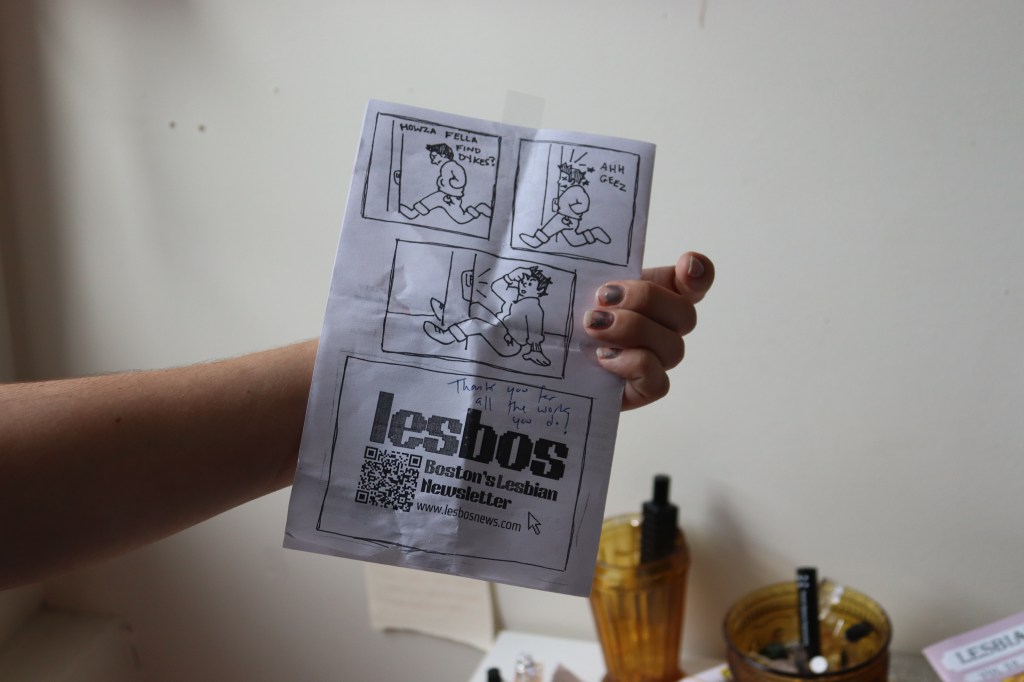
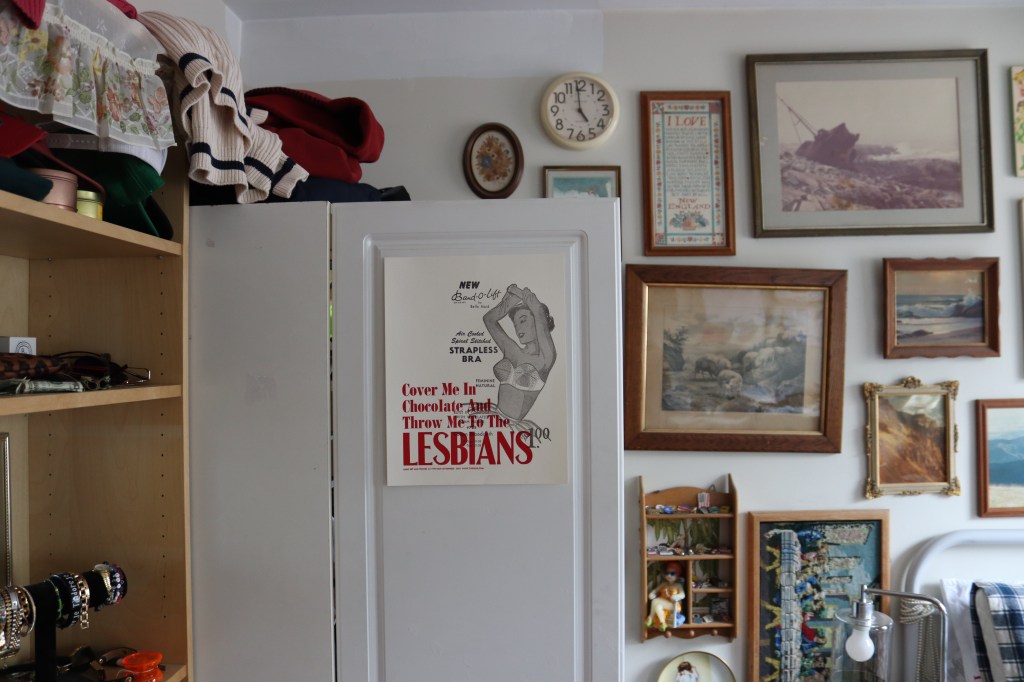
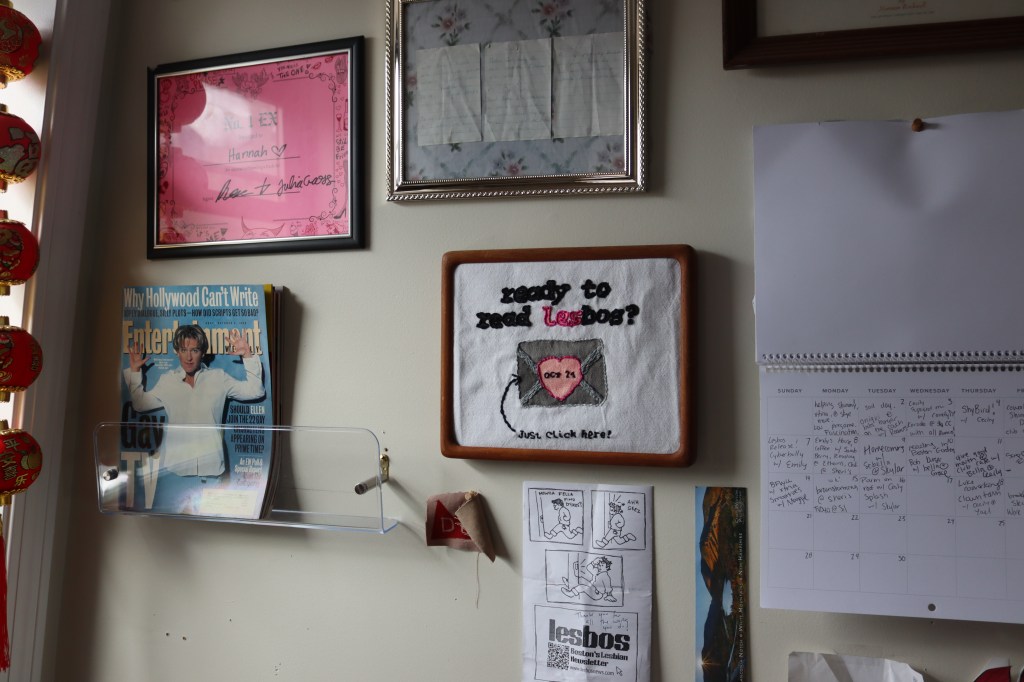
Hannah Jane’s fourth-floor Boston apartment, nestled in a quiet nook of a bustling downtown neighborhood, is a treasure trove of lesbian history.
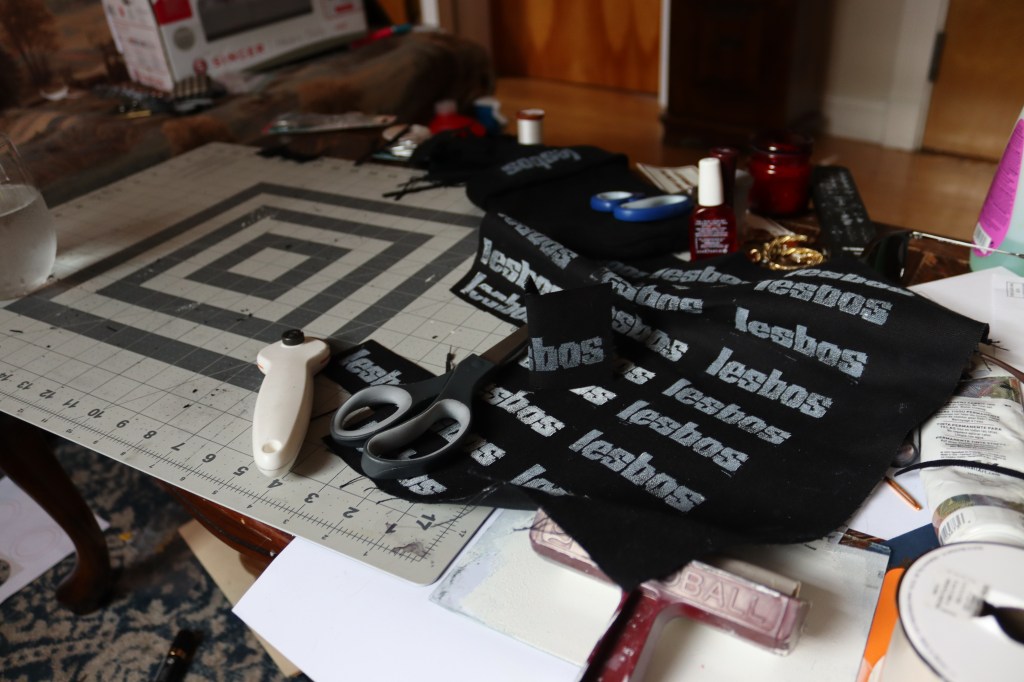
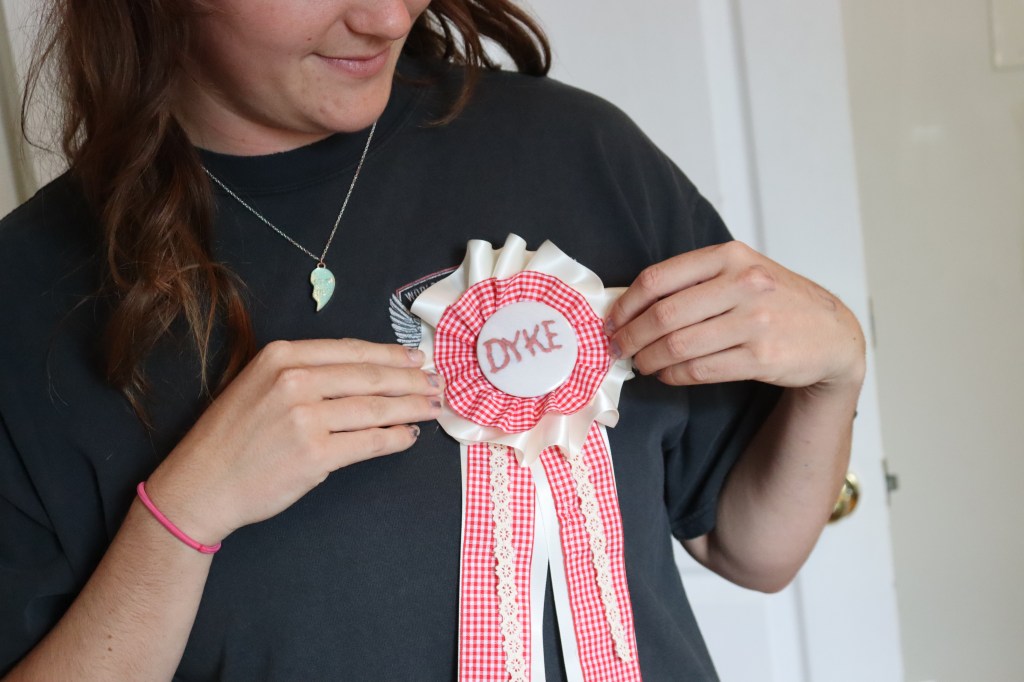
The key to the trove is Hannah’s (who only uses her first and middle name for lesbos purposes) brain. Its contents manifest themselves in colorful Zines, stickers, pins, flyers, posters, and a plethora of fabric for merch throughout various rooms and drawers. The apartment is no longer just a living space, but the birthplace of culture.
A year ago, on Oct. 11, Hannah, 25, sat at her dining table and hit send on the first issue of “lesbos.”
In simple terms, lesbos is Hannah’s brainchild for a newsletter for Boston lesbians. The ultimate goal of her ambition is even simpler.
“I want Boston to be the lesbian capital,” she said. “I want people to be like, ‘Oh, you’re a lesbian? You should move to Boston.’”
But what lesbos has become since its inception is harder to define.
At the beginning of each month lesbos subscribers—there are currently over six thousand of them, along with more than 14.5 thousand followers across social media platforms—receive an email with a brand new edition of the newsletter. It contains a calendar of lesbian events in the Boston area, written and visual submissions from local lesbians, history from various decades pertinent to the Boston lesbian community, an advice column called “Ask Edna,” and much more. In the Oct. 2024 issue, Hannah listed 35 events in the calendar. In the most recent Oct. 2025 issue, she included over 220.
Since its first edition, lesbos has leaped from the email inbox to the physical page—in zines with themes like “Wet Hot Lesbian Summer,” and brochures that explore lesbian history, such as the Boston chapter of the Daughters of Bilitis. It has also leaped from the page to the physical space—lesbos has organized and hosted 16 community events—most recently a Lesbian County Fair on Boston Common.
What most loyal lesbos subscribers have yet to find out, however, is that behind the bustling events, intricate zine designs, clever marketing, and detailed organization, the newsletter is a one-person operation. This ambiguity has helped Hannah establish her brand in a more serious fashion.
“That’s the gag,” she said. “I very much use the we/us pronouns. Especially at the beginning, you have to put up a strong front.”
Thankfully, Hannah said, she is able to rely on the help from her roommates, friends, and even her mother, who she credits as always having been very supportive. Hannah recognizes much of her mother’s influence in her newsletter endeavor.
“It’s been fun doing work now, where I’m like ‘Oh, this is so related to how I grew up,’” she said. Her mother, a “huge history buff,” instilled the value of learning about history in Hannah and her two brothers from an early age. Instead of family vacations, they went to historical sights—battlegrounds and ruins.
“Now when I write the newsletter and there’s so much history in it, I’m like, ‘this is so my mom core,’” Hannah said, laughing.
Hannah’s commitment to building the newsletter is as personal as it is communal. At its core, it is rooted in an unwavering commitment to Boston, a city that she fell in love with five years ago.
Hannah was born and raised in Toronto, Canada, though she has American citizenship through her mother. Her family eventually moved to California when she was 12. After moving in with her brother in Boston in 2020, to take a gap year from Vassar, Hannah decided to transfer to Emerson, where she completed a degree in business of creative enterprises. After college, she found that most of her peers left Boston, searching for community and activities in places that had seemingly more to offer. But Hannah knew that there was potential to build something great right where she lived.
While she was still at college, Hannah’s craving for lesbian community was fulfilled by being in a relationship with a woman. When her girlfriend moved to Los Angeles after graduating and their relationship ended, Hannah was inspired to find community elsewhere.
The idea for a lesbian newsletter had been kicking around Hannah’s brain for a while before she spoke her desire to start it aloud. Hannah said that she is usually shy to share her ideas. At Emerson, she dropped out of the film program after just one day when she realized it was not her personality to be self-promotional. This also contributed to her decision to stay in the background of lesbos until now. The lesbian newsletter, however, felt bigger than her from the start, so she brought it up to her friends one night as the group was standing outside of Boston’s downtown bar, The Tam.
“Guys, I have this thing I want to do,” Hannah said shyly. “I want to make a newsletter for lesbian Boston, and I want to call it lesbos, like a lesbian Boston.”
Building something from the ground up takes a lot of dedication. This January, Hannah quit her daytime job as an executive assistant to focus full-time on lesbos. “Not because running a free newsletter is really lucrative,” she said. “But because I really felt like if I dedicated more time to it, more can happen.” There is no fee attached to any part of the newsletter or its activities, but readers are able to offer financial support through donations and merchandise sales.
Though Hannah has been visible as the leader of lesbos and has been upfront with people who have directly asked about who the lesbos team really is, this month she plans to officially “come out” as the sole organizer of lesbos in hopes of giving people insight into how the brand runs as well as raising funds to sustain it.
It is all worth it if it brings just two people together in a positive way that otherwise would have never met, she said. Hannah understands the struggle to find lesbian-specific events and spaces all too well, and it’s not a new issue.
Throughout history, lesbians have had an issue with visibility, especially in the physical sense. For example, per the 2025 numbers from the Lesbian Bar Project, there are 38 lesbian bars across the country—that’s just 4.8% of all queer bars.
Hannah said there are a lot of community-hosted events, but a lot of it is word of mouth. “It’s just hard if you don’t know,” she said, reflecting on the lack of resources to find information about events before the lesbos calendar. “…but not anymore.”
Hannah’s mission was not just to point lesbians to lesbian-centered events, but also to remind them that they are not the first to try to find community. Just because information is hard to find, Hannah said, doesn’t mean that a beautiful and important history doesn’t exist.
On a late July evening this summer, Hannah fulfilled her goal of bridging the generational lesbian gap when she invited lesbians of all generations to come gather at Cambridge’s Cafe Zing. This marked the first Intergenerational Lesbian Coffee Shop event hosted by lesbos.
There, Hannah led an interview with the now late Mary Leno and Sarah Boyers, two prominent figures in Boston’s lesbian community, in front of a crowd of excited younger lesbians. The older women shared stories from living their lesbian lives in Boston. Afterwards, the group began a lively conversation, with listeners given the chance to ask questions.
If she had more time, these are the kinds of events she would focus on, Hannah said. It’s not surprising that the intergenerational coffee shop was received so enthusiastically. Many lesbians don’t grow up seeing themselves reflected in the older generations.
“I did the easy thing of saying, ‘Hey, old lesbians are going to be somewhere,” Hannah said. “People just showed up.”
It’s something she thinks will help people connect with being a lesbian in Boston.
“So they don’t have to feel like they are the first lesbian to ever be here and look for other lesbians,” Hannah said. “It’s so comforting and beautiful to see the ways it’s happened throughout history—history that is still alive and here.”
The event did more than just connect generations; it canonized Boston as a city that has queer history. A city where lesbians have lived and loved.
“History is everything in that sense,” Hannah said. “The second you lose history, you lose everything that’s ever happened.”
Lesbos events continue to grow, and the event calendar keeps expanding. Hannah has no plans to stop—and no plans to leave the city.
Her original hope of connecting people to a community has blossomed.
“There’s this girl I know, and I ran into her at a coffee shop,” Hannah said. “She said, ‘Remember that girl I told you about that I met at field day [lesbos event]? She’s my girlfriend now.’”
This is not an isolated occurrence. A few weeks ago, Hannah started weeping over her phone when a follower tagged her in a post. They had made a maroon crochet art piece that said “I [heart] lesbos.”
“In June, we wondered how we were going to make this move by ourselves,” the caption read. “By September 1, the beautiful people we bonded with at Lesbos Field Day had moved us into our new lesbian home.”
That is what lesbos is.
“I work all the time doing the fluff and the stupid stuff to make the IG look pretty,” Hannah said. “But really it’s just naming a time and a place and then everyone else does the work of showing up…That’s been the coolest part about the response—feeling like there’s this energy now of people who just want to be in community.”
As Hannah works on her events with her friends, they often look at the crowd of lesbians gathered at the event, talking, laughing, and creating community.
“Remember that night you said you wanted to start a newsletter?” they ask.


 Popline News