
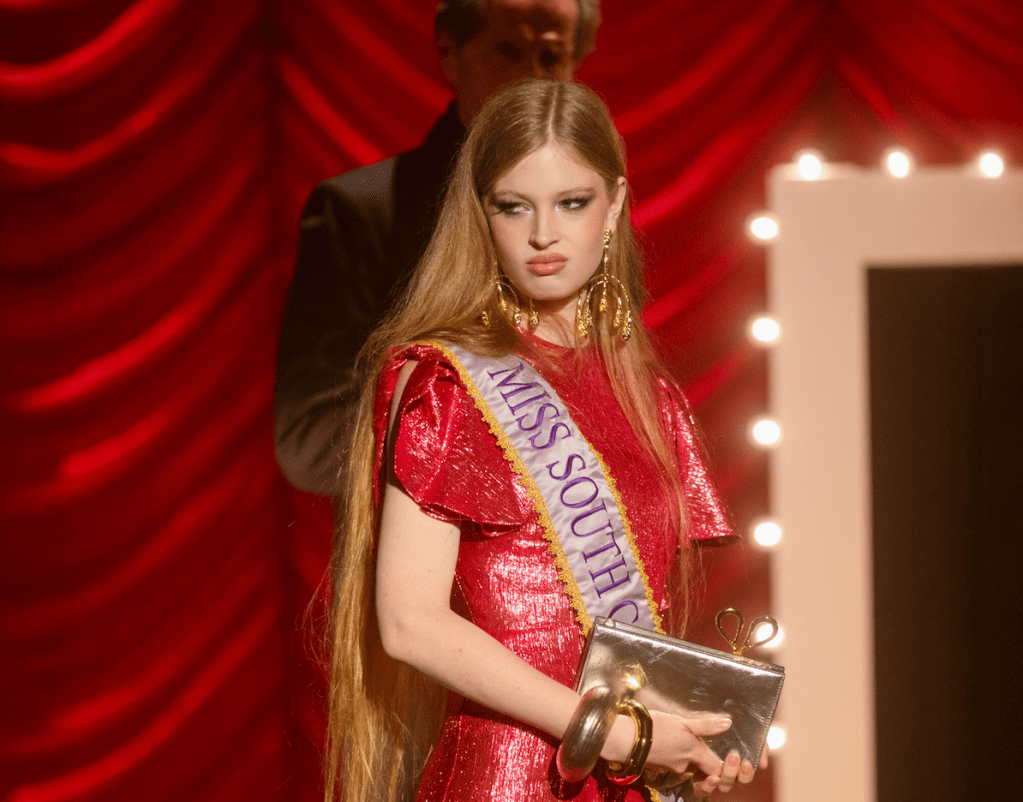
The 21-year-old trans model graced the stage at the Abrons Theater during acclaimed designer Alexis Bittar’s Spring/Summer 2026 presentation, titled “Miss USA 1991: A Dream Sequence”. Framed as a surreal, pageant-inspired performance piece, the show fused early ‘90s Americana with haunting cinematic references– David Lynch’s “Blue Velvet”, Brian De Palma’s “Carrie”, and “The Virgin Suicides” among them– to look at themes of misogyny, objectification, and the erosion of trans rights in the U.S.
Wilson, who represented Miss South Carolina —a state currently embroiled in legislative battles over trans rights— strode across the stage in a glittering red gown with ruffled sleeves. Her look was completed with bold sculptural gold earrings and one of Bittar’s signature “Scissor” clutches. Her sash read simply, ‘Miss South Carolina,’ but the subtext was unmistakable.
“I purposely cast each contestant to represent a U.S. state where trans rights are under assault,” Bittar shared in a statement. “This collection is a story about misogyny, unchecked predators, objectification, and trans rights.” Wilson was one of several trans models cast in symbolic roles as state contestants– alongside Amara Giselle (Miss Florida), Tommy Dorfman (Miss West Virginia), and others.
Theatrics aside, the show wasn’t just about fashion; it was a searing piece of performance art. A masked audience symbolized passive societal judgment. A hyper-masculine host parodied the spectacle of power. And Wilson’s presence in the lineup, already an outspoken critic of her father’s transphobic rhetoric, felt like a full-circle moment of defiance and visibility.
On Instagram, Bittar thanked Wilson directly: “Thank you for trusting me @vivllainous and for honoring me with your first show as Miss South Carolina.”
While the NYFW runway marked Wilson’s formal modeling debut, it wasn’t her first time owning the catwalk. In May, she appeared at the “RuPaul’s Drag Race All Stars” Season 10 premiere in NYC, where she vogued with confidence and flair.
Earlier this year, she also starred in a campaign for gender-inclusive fashion label Wildfang, designing a custom shirt that read: “Existing shouldn’t be revolutionary.” For Wilson, existing authentically is not only revolutionary– it’s political.
Wilson publicly came out as transgender in 2020 at age 16, and legally changed her name to Vivian Jenna Wilson, distancing herself from her father’s surname. She also cut off contact with Elon Musk, who has repeatedly deadnamed her and dismissed her transition as the result of being “tricked” into signing off on gender-affirming care.
“I don’t wish to be related to my biological father in any way, shape, or form,” she stated in her 2022 court petition. In an interview with Teen Vogue, she referred to Musk as “a pathetic man-child” and said, “I don’t give a f**k how much money anyone has.”
Despite being born into one of the wealthiest families in the world, Wilson has spoken openly about not receiving a large inheritance. “People assume I have a lot of money. I don’t.” She told The Cut. “I can afford food. I have friends, a shelter, and some expendable income… which is more than many people my age in Los Angeles.”
Back to NYFW, Bittar’s “Miss USA 1991” presentation blurred the lines between fashion, protest, and art. With masked spectators, unsettling music, and hyper-symbolic visuals, the show drew inspiration from iconic films that explore repression, beauty, and disillusionment. Contestants weren’t just modeling, they were telling a story.
The accessories, often the centerpiece in Bittar’s work, told a parallel narrative. From fractured gold surfaces to translucent Lucite in sherbet hues, they embodied contradictions– fragility and power, nostalgia and disruption. Bittar said the performance was an homage to “surrealism, old cinema, and the tension between glamor and menace.”
Wilson’s casting wasn’t just headline-grabbing; it was intentional. Her presence spotlighted the lived reality of trans individuals in a country where rights are under threat. Her gown might have been glittered, but her message cut deeper.
Vivian Wilson’s first runway show may have taken place under the bright lights of New York Fashion Week, but her journey to that stage was anything but typical. It was shaped by more public estrangement, political resistance, and personal resilience than most models go through in their entire lives.
For a woman who had been rejected by wealth, power, and fame by association, her modeling debut marks a turning point. Not because it launches her career, but because it asserts her identity on her own terms.
In a world obsessed with billionaires and beauty, Wilson is carving out something far more powerful: authenticity. And as Miss South Carolina, under the blazing lights and ironic pageantry of “Miss USA 1991”, she didn’t just walk the runway– she walked right through the fire that is being trans in the American fashion industry.



 Popline News